
Course Overview
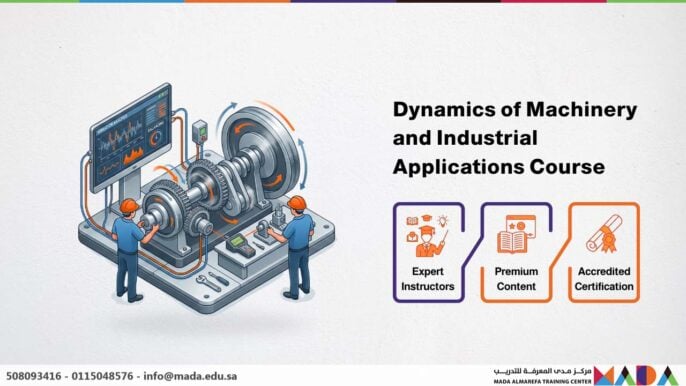
The Dynamics of Machinery and Industrial Applications course is a specialized program designed to equip participants with the essential theoretical skills to understand the principles of motion and the forces acting upon mechanical systems. This course is directly aligned with the requirements of the engineering job market, specifically tailored to meet the demands of rapid technological evolution in industrial sectors. Through this structured and systematic training program, participants will enhance their competitive edge in the professional landscape of mechanical engineering.
Course Objectives
- Grasp the fundamental concepts of dynamics and their relationship with mechanical systems.
- Analyze the forces acting on machinery and study their motion in industrial applications.
- Apply mathematical and physical principles to quantify motion parameters and acceleration.
- Study different types of vibrations and their impact on industrial machinery performance.
- Utilize theoretical models to optimize operational efficiency and reduce energy consumption.
- Address common operational issues through precise engineering solutions.
- Bridge the gap between dynamic theories and modern industrial realities, including smart manufacturing technologies.
Course Outline
Day 1: Fundamentals of Dynamics and Laws of Motion
- Introduction to the science of dynamics and its industrial significance.
- Newton’s Laws of Motion and their application in machinery analysis.
- Classification of linear and rotational motion.
- Core concepts: Mass, Force, and Acceleration in mechanical systems.
[Image of Newton’s second law of motion diagram]
Day 2: Analysis of Motion and Forces Acting on Machinery
- Rectilinear motion and its time-dependent variables.
- Force analysis across different axes (X, Y, and Z).
- Studying friction and its effects on machine performance.
- Practical applications of force calculations using mathematical equations.
Day 3: Rotational Dynamics and Torque
- The concept of Torque and its relationship with rotational motion.
- Moment of Inertia and its impact on rotating bodies.
- Analyzing rotational motion in motors and fans.
- Motion transmission analysis between gears and shafts.
Day 4: Mechanical Vibrations and Industrial Impacts
- Types of vibrations: Free, Forced, and Damped.
- Analyzing Natural Frequencies and their effect on machine lifespan.
- The relationship between vibration levels and operational efficiency.
- Methods for vibration reduction and damping in industrial environments.
Day 5: Industrial Applications and Case Studies
- Reviewing industrial facility case studies and analyzing dynamic failures.
- Applications of dynamics in Robotics and smart equipment.
- How dynamics influence the design of modern production lines.
- The future of machinery dynamics in the Fourth Industrial Revolution (Industry 4.0).

