
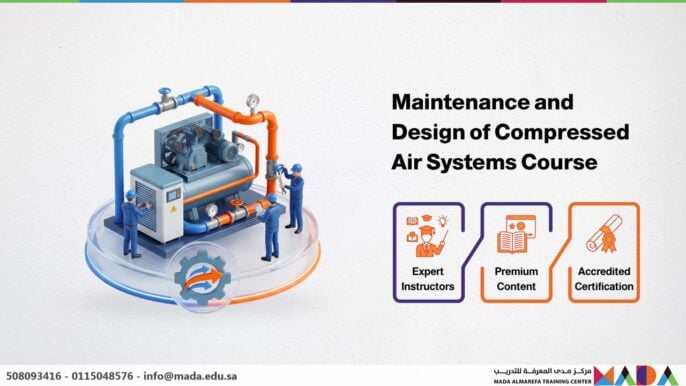
About the Course
The Maintenance and Design of Compressed Air Systems course is a specialized training program designed to meet the rigorous demands of the industrial and engineering sectors. This course aims to provide participants with the theoretical foundation necessary to understand system components, effective maintenance strategies, and high-performance design. By building a solid knowledge base in compressed air technology, graduates and interested professionals can significantly enhance their career prospects in industrial environments that rely on pneumatic power.
Course Objectives
- Understand the fundamentals of compressed air systems and their diverse industrial applications.
- Identify the primary components of compressed air systems and their specific functional roles.
- Acquire the theoretical skills needed for maintenance and fault analysis in pneumatic systems.
- Learn how to design compressed air systems that align with specific project requirements and loads.
- Develop the ability to evaluate system performance and implement efficiency improvements.
- Gain familiarity with international technical standards and specifications governing the field.
- Enhance technical and analytical intelligence to solve pneumatic system problems theoretically.
Course Curriculum
Day 1: Introduction to Compressed Air Systems
- The concept of compressed air and its strategic importance in modern industry.
- Classifying compressor types: Reciprocating, Rotary Screw, and Centrifugal.
- Primary system components: The Compressor, Aftercooler, Filters, and Valves.
- Safety protocols and best practices for handling high-pressure air systems.
Day 2: Design and Sizing of Compressed Air Systems
- Criteria for selecting the optimal compressor based on project scale.
- Calculating load requirements: Pressure (PSI/Bar) and Flow (CFM/m³/min).
- Piping network design: Materials, sizing, and air distribution strategies.
- Selecting and sizing accessories: FRL Units (Filters, Regulators, Lubricators).
Day 3: Troubleshooting and System Maintenance
- Identifying common failure modes in industrial compressed air systems.
- Theoretical diagnostic methods for unstable performance or pressure drops.
- Maintenance protocols for core components: Compressors, Valves, and Filtration units.
- Preventive and predictive measures to ensure long-term system reliability.
Day 4: Efficiency Optimization and Waste Reduction
[Image showing common air leak points in an industrial pneumatic system]
- Analyzing energy loss and the “cost of air” in industrial settings.
- Techniques for leak detection and managing inconsistent pressure demands.
- The importance of thermal insulation and efficient cooling in air systems.
- Reviewing technical specifications to achieve maximum energy savings and ROI.
Day 5: Measurements and International Standards
- Theoretical measurement tools used to analyze system performance and air quality.
- International standards and codes: ISO 8573 (Air Quality) and ANSI standards.
- Case Study: Theoretical design and maintenance plan for a large-scale industrial project.
- Discussing future challenges in design and maintenance for “Smart” industrial plants.
Conclusion
Mastering the design and upkeep of compressed air systems is essential for any professional looking to drive efficiency in the industrial sector. Because compressed air is one of the most energy-intensive utilities, understanding the theoretical nuances of Flow, Pressure, and Filtration is the key to reducing operational costs and ensuring equipment longevity. This course provides the structural knowledge required to lead pneumatic projects with technical confidence and precision.

