
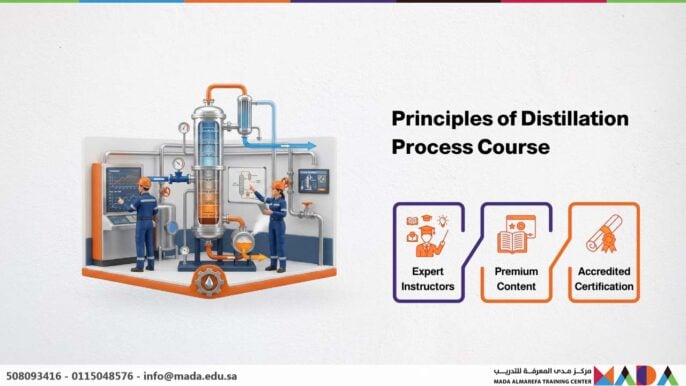
Course Overview
The Principles of Distillation Process course is a foundational step toward mastering industrial operations within the chemical and petrochemical sectors. This program provides participants with the essential theoretical knowledge to understand distillation mechanisms and their diverse industrial applications, significantly enhancing their competitive edge in the labor market. Learn the core principles of distillation alongside industry experts and arm yourself with the knowledge that opens doors to professional excellence.
Course Objectives
- Understand the fundamental concepts of the distillation process and its various types.
- Identify the components of industrial distillation systems and their operational principles.
- Study the variables directly affecting the efficiency of distillation processes.
- Analyze data related to separation processes using different technical methodologies.
- Recognize the critical importance of occupational safety while handling distillation systems.
- Apply theoretical principles to standard industrial case studies.
- Link distillation concepts to the evolving needs of modern industrial sectors.
Course Curriculum
Day 1: Introduction to the Science of Distillation
- Defining the distillation process and its strategic role in modern industry.
- Types of distillation processes utilized in the chemical industry.
- Process stages and the fundamentals of thermal separation.
- The relationship between pressure and boiling point in distillation dynamics.
Day 2: Design of Distillation Systems
- Components of a distillation column and the function of each part (Trays, Packing, Condensers, Reboilers).
- Classification of towers based on feed type and separation requirements.
- Hydraulic and thermal design principles for distillation systems.
- Material flow diagrams within distillation towers.
Day 3: Performance Variables and Distillation Efficiency
- Key factors influencing the efficiency of industrial distillation.
- The impact of mixture composition on separation performance.
- Energy analysis: Calculating the heat required for each stage of distillation.
- Case Study: Analyzing operational variables for an experimental system.
Day 4: Specialized Distillation Types
- Vacuum Distillation: Principles and molecular distillation techniques.
- Steam Distillation: Utilizing direct and indirect steam injection.
- Reactive Distillation: Applications in advanced industrial manufacturing.
- A comparative analysis between traditional and modern distillation methods.
Day 5: Industrial Applications of Distillation
- Distillation applications in the oil, gas, and petrochemical sectors.
- The role of distillation in water treatment and chemical recycling.
- Common operational challenges in large-scale industrial systems.
- The future of distillation technologies in green and sustainable industries.
Conclusion
In the world of chemical engineering, distillation remains the most critical separation technology. This course bridges the gap between basic chemistry and industrial application, providing participants with the clarity needed to manage high-performance separation units. Whether you are optimizing a refinery or a specialty chemical plant, understanding the nuances of thermal balance and hydraulic design is essential for professional excellence in today’s industrial landscape.

