
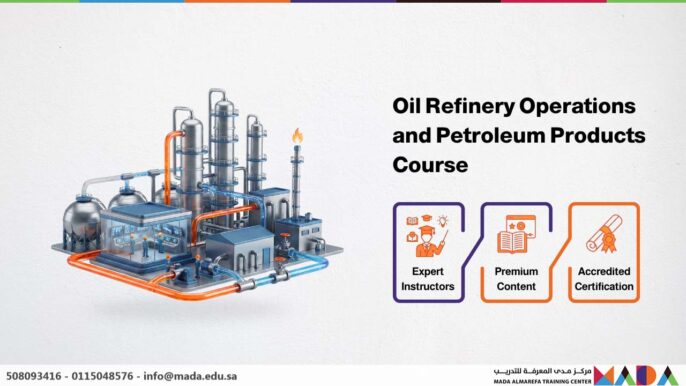
Course Overview
The Oil Refinery Operations and Petroleum Products course is a specialized program that provides participants with a comprehensive understanding of refining processes and the transformation of crude oil into high-value petroleum products. This course is meticulously designed to meet the demands of the global petroleum industry, equipping the workforce with the theoretical knowledge and technical skills required to navigate the latest technologies used in modern refineries.
Course Objectives
By the end of this program, participants will be able to:
- Comprehend the fundamental stages of oil refining and the manufacturing of various petroleum derivatives.
- Identify the primary processing units within a refinery and their specific operational roles.
- Acquire the analytical skills necessary to evaluate chemical and physical processes in a refinery setting.
- Learn the protocols for operating diverse processing units with maximum efficiency and safety.
- Master the use of technical tools and equipment used for monitoring daily refinery operations.
- Gain familiarity with international environmental and health standards governing oil operations.
- Enhance the ability to troubleshoot and address common operational challenges effectively.
Course Outline
Day 1: Introduction to the Refining Industry and Refinery Operations
- The concept of oil refining and the classification of refinery types.
- The role of various crude oil grades in production cycles.
- An overview of final petroleum products and their global applications.
- Market trends, challenges, and career opportunities in the refinery sector.
Day 2: Physical Processes in Oil Refineries
[Image of a fractional distillation tower diagram]
- The principles of separation via heating and fractional distillation.
- Designing and operating atmospheric and vacuum distillation towers.
- Fuel treatment techniques: Dehydration and extraction processes.
- Analyzing the impact of pressure and temperature on process efficiency.
Day 3: Chemical Processes in Petroleum Product Manufacturing
- Core concepts of Thermal Cracking and Catalytic Cracking.
- The chemistry behind producing high-octane gasoline.
- Hydrotreating and Hydrodesulfurization: Removing sulfur from fuels.
- How chemical reactions dictate the final quality and grade of the product.
Day 4: Processing Units and Product Enhancement
- Processing and refining heavy fuels: Cooling oils and fuel oil (Mazut).
- Purification techniques to remove impurities and hazardous elements.
- Fuel blending technologies and improving technical specifications.
- Economic analysis: Studying operational costs versus unit efficiency.
Day 5: Safety, Quality, and Environmental Standards
- Industrial safety principles for hazardous refinery environments.
- International quality standards (ISO/ASTM) for petroleum products.
- The environmental footprint of refining and modern mitigation strategies.
- The future of energy: Transitioning toward “Clean” and “Green” petroleum products.
Conclusion
Success in the petroleum industry requires a delicate balance of chemical precision and operational safety. This course provides the structural knowledge needed to manage that balance, ensuring that every barrel of crude oil is processed into the highest quality products possible. Whether you are looking to enter the field or refine your existing expertise, this program serves as a critical foundation for professional excellence in the energy sector.

