
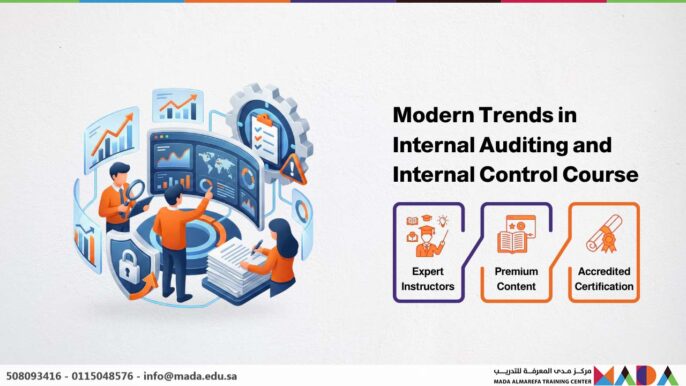
Course Overview
The Modern Trends in Internal Auditing and Internal Control course is an advanced theoretical training program designed to deepen understanding of the latest developments in institutional oversight and auditing within the digital age. This course focuses on the modern concepts reshaping the role of control functions—moving from traditional oversight to proactive control, adopting risk-based methodologies, and integrating technology into auditing processes.
The content is delivered through a purely theoretical framework, making it ideal for accountants, internal control staff, audit managers, and administrative leaders in both public and private sectors. Key themes include governance, transparency, and compliance, alongside modern tools such as Continuous Monitoring, predictive analytics, and the application of Artificial Intelligence (AI) in detecting irregularities. It also highlights the strategic integration between auditing functions and senior leadership to support sustainability and protect corporate assets.
[Image of COSO Internal Control Framework]
General Objective
The primary goal of this program is to enable participants to gain a deep theoretical understanding of contemporary internal control developments. It focuses on designing effective, flexible, and adaptable control systems capable of meeting modern operational and digital challenges. The program seeks to build the trainees’ capacity to analyze modern control models, understand the impact of digital transformation on auditing, and leverage Big Data to enhance oversight accuracy. It encourages a shift from reactive auditing to a proactive, risk-assessment-based strategy that secures the organization’s future.
Detailed Learning Objectives
- Understand modern internal control concepts and their vital role in contemporary organizations.
- Identify the transition in auditing methodologies from traditional to digital-first approaches.
- Recognize the role of technology and AI in enhancing oversight precision.
- Learn the theoretical application of Risk-Based Auditing (RBA).
- Understand the integration of internal control with corporate governance and strategic decision-making.
Course Curriculum
Day 1: Evolution of Internal Control
- Defining internal control and its importance in modern work environments.
- The transition from paper-based to digital oversight.
- COSO and ISO 31000 standards and their impact on control practices.
- The role of control in supporting institutional transparency and accountability.
Day 2: Modern Auditing Methodologies
- The concept of Risk-Based Auditing (RBA).
- Proactive planning for inspections and identifying audit priorities.
- Utilizing preliminary analytics to predict organizational weaknesses.
- The importance of flexibility in designing modern audit plans.
Day 3: Technology and Smart Control
- The role of ERP systems in supporting internal control mechanisms.
- Using Automated Analytics to detect anomalies and patterns.
- Applications of Artificial Intelligence and Machine Learning in auditing.
- Continuous Monitoring vs. periodic inspection.
Day 4: Governance and Digital Compliance
- The relationship between Governance, Risk, and Compliance (GRC).
- Ensuring compliance with local and international regulations (e.g., SOX, GDPR).
- Theoretical management of operational and financial risks.
- The importance of interactive reporting and comprehensive performance assessment.
Day 5: The Future of Internal Control
- Concepts of proactive and preventive control strategies.
- Building a “Control Culture” within the organization.
- The role of training and awareness in enhancing institutional compliance.
- Future trends: Blockchain, Cloud Computing, and Automated Auditing.
Conclusion
The Modern Trends in Internal Auditing and Internal Control course is a pivotal element in building professional competencies that can keep pace with rapid business shifts. In an era defined by digitization and complex organizational structures, this course is essential for financial and administrative leaders. It fosters the ability to evaluate control systems, mitigate risks, and prevent fraud before it occurs. By mastering these modern trends, professionals can ensure organizational stability, efficiency, and long-term institutional trust.

