
Course Overview
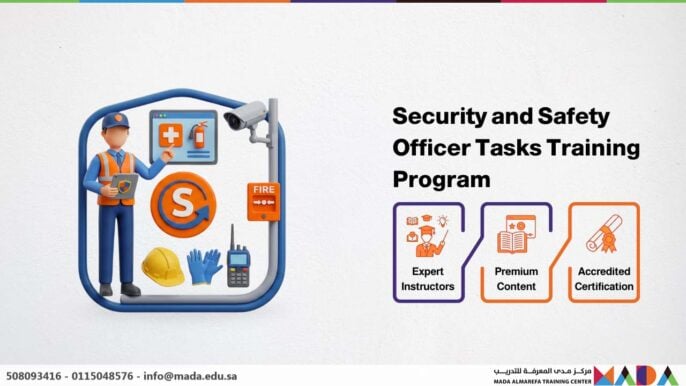
The Security and Safety Officer Tasks Training Program is a specialized theoretical course designed to professionally and intellectually qualify individuals to understand the roles and responsibilities of security and safety personnel within vital organizations and sites. The course focuses on establishing a comprehensive understanding of physical security principles, ensuring workplace safety, and protecting both personnel and property, with a strong emphasis on behavioral, organizational, and preventive aspects.
The content is delivered entirely through a theoretical framework, without the need for practical exercises, field training, or the use of security equipment. This makes it ideally suited for new hires, candidates joining security and safety teams, or administrators wishing to understand the nature of operations in this field. Key topics include surveillance concepts, hazard identification, emergency handling, crowd management, professional conduct, effective communication, and the discipline required for duty. It highlights the security officer’s role as a vital link between management and the operational environment, contributing to a secure and organized workplace.
[Image: Professional security officer in a monitoring room]
General Objective
This program aims to provide participants with an in-depth theoretical understanding of the functional and professional framework of a security and safety officer. It focuses on daily tasks, response mechanisms, and the core principles of safety and prevention. The program seeks to build the trainees’ capacity to analyze potential risks, understand emergency protocols, and support security stability within a site. It also emphasizes commitment to regulations, disciplined performance, and professional interaction with visitors and staff. No prior security experience is required, as the course provides a systematic foundation for professional conduct and organizational protection.
Specific Learning Objectives
- Understand the fundamental concepts and tasks of security and safety officers within organizations.
- Identify various types of security and health risks encountered during duty.
- Recognize the importance of continuous monitoring and periodic patrols in accident prevention.
- Learn the protocols for handling and accurately reporting emergency situations.
- Understand the role of professional behavior and effective communication in successful task execution.
Course Curriculum
Day 1: Introduction to Security and Safety Roles
- Defining the tasks and importance of the security and safety officer in an organization.
- Distinguishing between physical security, occupational safety, and administrative security.
- Primary roles: Surveillance, guarding, and early warning systems.
- The relationship between security personnel and other departments (Safety, Operations, HR).
Day 2: Workplace Safety Principles
- Common Hazard Types: Electrical, mechanical, fire, and fall hazards.
- The concept of prevention and the officer’s role in supporting a safety culture.
- Identifying safety equipment and emergency locations (extinguishers, evacuation exits).
- The importance of immediate reporting of violations or hazards.
[Image: Workplace safety hazards and warning signs]
Day 3: Surveillance and Security Patrols
- The concept of security patrols and their objectives (detection, documentation, prevention).
- Steps for preparing patrol plans and identifying critical/high-risk areas.
- The significance of security records and Logbooks.
- Handling intrusions or unauthorized entries from a procedural standpoint.
Day 4: Handling Emergency Situations
- Emergency Types: Fires, accidents, threats, or civil disturbances.
- Reporting procedures and the activation of emergency response plans.
- Coordination with response teams (Firefighters, Medical units, Central Security).
- The officer’s role in organizing evacuations and protecting lives.
[Image: Emergency evacuation and response coordination]
Day 5: Professional Conduct and Effective Communication
- Standards of professional behavior: Calmness, discipline, and professionalism.
- Techniques for interacting politely and effectively with visitors, employees, and guests.
- Verbal communication skills and technical security report writing.
- The importance of confidentiality and protecting sensitive information.
Conclusion
The Security and Safety Officer Tasks Training Program is an essential building block for creating a conscious and professional workforce capable of protecting facilities and individuals. This course is highly relevant for those working in building security, industrial facilities, and commercial complexes. It enhances the ability to understand operational requirements, make sound decisions in challenging situations, and maintain a disciplined environment. In a world that demands constant vigilance, mastering these security tasks ensures protection, prevents accidents, and achieves operational stability through advanced theoretical knowledge and a commitment to duty.

