
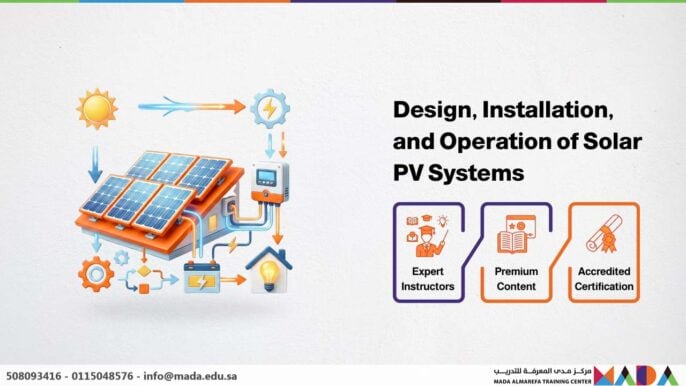
General Overview
The Design, Installation, and Operation of Solar Photovoltaic (PV) Systems course is an advanced training program aimed at building a solid theoretical foundation in renewable energy. Specifically, it focuses on PV systems used to generate electricity from sunlight. This course is designed to provide participants with comprehensive knowledge of solar system components, design mechanisms, and operational principles without including practical field activities.
The course emphasizes conceptual and engineering aspects, providing detailed explanations of solar panel types, charge controllers, inverters, and battery storage systems. It also explores optimal operating conditions and environmental impact factors. The content is structured to enhance the technical competence of engineers, technicians, and those interested in transitioning to clean energy sources, aligning with global sustainability trends.
[Image of basic components of a solar photovoltaic system]
General Objective
The program aims to empower participants with advanced theoretical understanding of the foundations for establishing and operating solar systems, from the initial design phase through component selection to performance monitoring. It seeks to develop the trainees’ ability to analyze system requirements based on usage (residential, commercial, or industrial) and understand how components integrate with the electrical grid or function as standalone (off-grid) systems. The program also emphasizes safety, efficiency, and preventive maintenance to ensure operational continuity.
Detailed Objectives
- Understand the fundamental concepts of solar PV energy and its various applications.
- Identify the main components of a solar system and the specific functions of each.
- Grasp design principles based on consumption requirements and environmental conditions.
- Learn how to accurately select inverters, batteries, and charge controllers.
- Develop a theoretical understanding of operation, monitoring, and performance analysis mechanisms.
Course Curriculum
Day 1: Introduction to Solar Photovoltaic Energy
- Definition of Solar PV energy and its importance in the future energy mix.
- Differences between Grid-Tied (On-grid) and Standalone (Off-grid) systems.
- Applications of solar systems in residential, industrial, and agricultural environments.
- Overview of the global transition toward renewable energy sources.
[Image of difference between on-grid and off-grid solar systems]
Day 2: System Components and Functions
- Detailed explanation of solar panel types: Monocrystalline, Polycrystalline, and Thin-film.
- The role of the Inverter in converting Direct Current (DC) to Alternating Current (AC).
- Battery types used for storage: Lead-acid and Lithium-ion.
- Functions of Charge Controllers and system protection measures.
Day 3: Theoretical System Design
- How to perform a Load Assessment based on consumption patterns.
- Sizing solar arrays based on regional solar irradiance.
- Calculating battery capacity according to required backup periods.
- Designing for environmental conditions: temperature, dust, tilt angles, and shading.
Day 4: Safety, Protection, and Grid Integration
- Electrical safety standards for solar energy systems.
- Protecting the system from lightning, short circuits, and overvoltage.
- Mechanisms for connecting to the public utility grid (Grid-tie systems).
- Understanding Net Metering and its economic benefits.
Day 5: Operation, Monitoring, and Theoretical Maintenance
- Concepts of stable system operation and load management.
- Remote monitoring tools for analyzing real-time system performance.
- The importance of periodic maintenance for sustained efficiency.
- Theoretical analysis of common faults and troubleshooting methods.
Conclusion
The Design, Installation, and Operation of Solar PV Systems course is a vital program in the context of the global shift toward clean energy and the reduction of fossil fuel reliance. This course is primarily directed at electrical engineers, renewable energy technicians, energy sector planners, and entrepreneurs in the “green” project space.
Through this curriculum, participants gain a comprehensive understanding of how solar systems function, enabling them to evaluate appropriate solutions and make informed design decisions. In light of international support for renewable energy, this knowledge is a key element in building a workforce capable of achieving sustainability goals and reducing carbon footprints. This course represents a strategic step toward empowering professionals to embrace a clean, secure, and sustainable energy future.

