
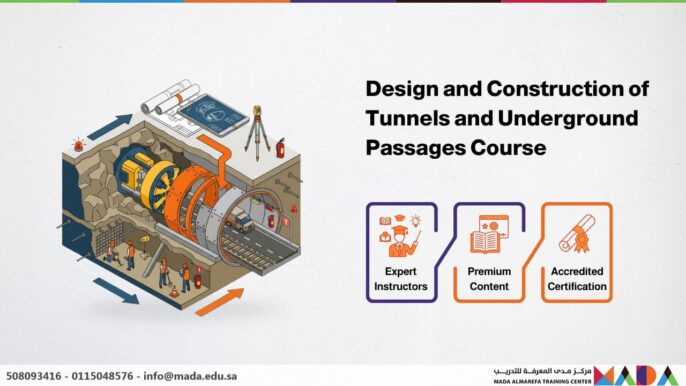
Tunnel and underground passageway projects serve as vital lifelines for modern infrastructure development, playing a crucial role in easing urban traffic congestion and securing dependable underground utility corridors. This training course offers an end-to-end engineering curriculum spanning the full lifecycle of tunneling projects: from comprehensive geological and geophysical site characterization and soil mechanics, to selecting advanced shallow and deep excavation techniques, designing structural support linings, ventilation, and drainage systems, through to construction safety protocols, geotechnical monitoring, and the integration of Building Information Modeling (BIM) and smart digital workflows to ensure structural longevity and operational safety.
Course Objectives
- Master the fundamental engineering principles required to plan and design diverse classifications of tunnels and subterranean passageways.
- Develop advanced competencies in interpreting geological and geotechnical site investigation reports to evaluate ground risks, groundwater pressures, and alignment optimization.
- Evaluate and compare mechanized excavation methods—including Tunnel Boring Machines (TBMs)—against conventional Drill and Blast and Cut-and-Cover methodologies.
- Apply international structural design standards to temporary ground support systems, permanent precast segmental linings, mechanical ventilation, and groundwater ingress control.
- Implement rigorous health and safety standards, continuous geotechnical monitoring programs, and BIM workflows for collaborative underground project delivery.
Target Audience
- Civil, geotechnical, structural, and infrastructure engineers.
- Project managers and construction directors overseeing tunneling ventures, metro networks, and public utilities.
- Quality control (QC) engineers, site inspectors, and occupational health and safety (HSE) officers working on subterranean jobsites.
- Consulting engineers, structural designers, and urban planners working across engineering consultancies, contracting firms, and municipal authorities.
Course Outline
This 5-day curriculum covers the core facets of underground engineering through the following daily modules:
Day 1: Introduction to Tunnels and Underground Passageways
- Definition and Classifications: Transportation tunnels, rapid transit networks, stormwater interceptors, and multi-utility tunnels (MUTs).
- Urban Infrastructure Value: Enhancing land-use efficiency, urban connectivity, and environmental sustainability.
- Engineering and Environmental Challenges: Managing ground variability, high groundwater tables, surface structural surcharge, and urban settlement limits.
- Case Study Analysis: Reviewing regional and global benchmark tunneling projects, highlighting key structural challenges and lessons learned.
Day 2: Geotechnical Investigations and Subsurface Assessment
- Site Characterization: Planning and executing borehole programs, in-situ testing, and geophysical seismic surveys prior to excavation.
- Soil and Rock Mechanics: Rock mass rating systems (RMR, Q-system, GSI) and their practical influence on initial support calculations.
- Hydrogeological Assessments: Evaluating pore water pressures, permeability, and groundwater flow regimes.
- Ground Risk Mitigation: Estimating lateral earth pressure profiles, face stability, and ground settlement troughs.
Day 3: Tunnel Excavation Technologies and Construction Methods
- Tunnel Boring Machines (TBM): Selection criteria, mechanical components, and operational trade-offs for Earth Pressure Balance (EPB), Slurry, and Hard Rock TBMs.
- Drill and Blast Method (NATM / SEM): Drilling patterns, explosive charging, blast sequencing, and perimeter vibration controls in rock formations.
- Cut-and-Cover Techniques: Bottom-up versus top-down construction sequences for shallow tunnels and underground metro stations.
- Microtunneling and Trenchless Technology: Pipe-jacking applications and precision guidance systems for non-disruptive utility installations.
Day 4: Structural Support Design, Operational Systems, and Life Safety
- Lining Design & Materials: Cast-in-place concrete linings versus precast concrete segmental rings with elastomeric gasket seals.
- Initial Support Systems: Lattice girders, steel sets, rock bolts, wire mesh, and fiber-reinforced shotcrete applications.
- Underground MEP & Life Safety: Aerodynamic longitudinal and transverse ventilation design, operational illumination, and pressurized emergency egress cross-passages.
- Waterproofing and Drainage: High-performance polymer sheet membranes, contact grouting, drainage channels, and sump pumping stations.
Day 5: Safety Management, Structural Health Monitoring, and Digital Trends
- Underground Risk Control: Atmospheric monitoring (toxic and explosive gases), fire life safety, and emergency evacuation protocols.
- Geotechnical Instrumentation: Real-time convergence monitoring, total stations, surface leveling arrays, and piezometer data logging.
- BIM and Digital Twins: 3D clash detection, 4D construction scheduling, and digital fabrication of precast segments.
- The Future of Smart Tunnels: Utilizing Internet of Things (IoT) sensor arrays and predictive AI models for long-term structural maintenance.
Course Impact and Key Takeaways
Participants will gain a systematic, technically rigorous framework that enables them to make critical engineering decisions regarding tunnel alignment selection, ground stabilization, and mechanized method selection. Furthermore, they will acquire the skills needed to design, review, and inspect structural support systems while managing subterranean safety hazards—directly driving down delivery costs, minimizing project delays, and eliminating costly field reworks.
Register today to gain practical, world-class engineering expertise and prepare yourself to lead complex tunneling and underground infrastructure projects.

