
General Overview
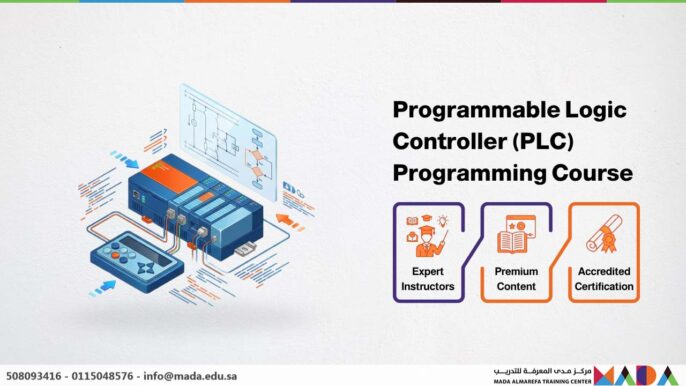
The Programmable Logic Controller (PLC) Programming Course is a specialized theoretical training program designed to provide a comprehensive understanding of how PLCs function and their critical role in modern industrial systems. As industrial automation continues to evolve, PLCs have become the backbone of production line operations and technical process control. This makes a solid grasp of PLC programming principles essential for anyone working in electrical engineering, electronics, and industrial control systems.
General Objective
This course aims to equip participants with the theoretical knowledge required to understand PLC architecture, operational mechanics, and the design of logic programs that manage various industrial processes. Trainees will learn to analyze control systems and understand the transition from manual operations to fully automated processes using PLC software frameworks.
By the end of the program, participants will be familiar with different types of controllers, system components, and various programming methodologies. This training serves as a vital stepping stone toward building a robust theoretical foundation for advanced industrial environments.
Detailed Learning Objectives
- Understand the concept of Programmable Logic Controllers (PLCs) and their pivotal role in industrial automation.
- Identify the core components of a PLC system and the relationship between hardware and software.
- Explore different programming languages used in the industry.
- Analyze industrial processes to determine effective control strategies using PLCs.
- Develop the ability to design theoretical logic programs that meet specific automation requirements.
Course Curriculum
Day 1: Introduction to Programmable Logic Controllers
- Definition of PLC and its importance in industrial settings.
- Key differences between traditional relay logic control and PLC systems.
- The primary hardware components: CPU, Input modules, and Output modules.
- Overview of the leading PLC brands and types available in the market.
Day 2: PLC System Architecture
- The inner workings of the Central Processing Unit (CPU).
- The role of I/O (Input/Output) units in process control.
- Communication between peripheral devices and the main controller.
- Understanding scan cycles and the importance of timing in command execution.
Day 3: PLC Programming Methodologies
- Ladder Diagram (LD): Theoretical principles and logic flow.
- Structured Text (ST): Use cases and high-level programming logic.
- Function Block Diagram (FBD): Visualizing logic through functional blocks.
- Criteria for selecting the appropriate programming language for specific applications.
Day 4: Theoretical Logic Program Design
- Standard steps for building a control program.
- Analyzing industrial workflows and identifying critical control points.
- Drafting code based on required operational logic.
- Theoretic troubleshooting and reviewing design errors.
Day 5: Industrial Applications and Future Trends
- Case studies of PLC implementation in production lines.
- Controlling motors and pumps through automated programming.
- Managing HVAC and lighting systems in “Smart Buildings.”
- The role of PLCs in improving efficiency and reducing operational errors.
Conclusion
The PLC Programming Course is a foundational program for engineers, technicians, and students aiming to excel in industrial automation. It offers a deep dive into logic design and system analysis without the immediate need for field testing, making it perfect for those building their technical expertise. Organizations benefit by cultivating a workforce that understands the “brains” of their operation, ultimately driving productivity and supporting the global shift toward Industry 4.0.

