
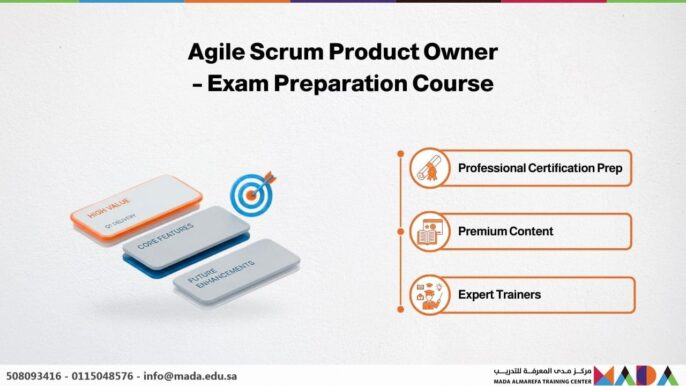
The Product Owner certification is considered one of the most important professional credentials in the era of digital transformation, as it focuses on maximizing product value and ensuring return on investment (ROI). This 2026 course has been designed to equip you with the leadership and business skills required to transform organizational vision into tangible outcomes, with a strong emphasis on Product Backlog management and effective stakeholder communication.
This course does not grant a standard attendance certificate; rather, it is an intensive preparatory program specifically designed to qualify you to successfully pass the official examination (such as PSPO from Scrum.org or CSPO from Scrum Alliance). The course aims to professionally prepare you to become the leader accountable for a product’s commercial and technical success.
Course Objectives
- Understand the Product Owner role as the primary individual responsible for maximizing the value generated by the Scrum Team.
- Master product vision formulation and product roadmap development skills.
- Learn techniques for managing and prioritizing the Product Backlog based on business value and impact.
- Understand how to balance stakeholder needs with the technical capabilities of development teams.
- Apply release planning strategies and manage expectations within dynamic and changing environments.
- Prepare candidates to pass the official exam by mastering complex decision-making and scenario-based questions.
Detailed Training Content
Unit 1: The Product Owner Role in Scrum
- Accountability for value: how does the Product Owner measure success?
- Product Owner versus Product Manager: key distinctions within Agile contexts.
- Team collaboration: the relationship between the Product Owner, Scrum Master, and Developers.
- Decision-making authority and the importance of Product Owner empowerment for project success.
Unit 2: Product Vision and Strategy
- Crafting the product vision using techniques such as the Product Vision Board.
- Product roadmap development: long-term planning within Agile environments.
- Stakeholder management: identification, analysis, and handling conflicting expectations.
- Product economics: understanding total cost of ownership, revenue models, and present versus future value.
Unit 3: Product Backlog Management
- Backlog creation: writing effective user stories and defining acceptance criteria.
- Prioritization techniques using models such as MoSCoW, the Kano Model, and ROI-driven ordering.
- Backlog refinement: transforming high-level ideas into actionable backlog items.
- Transparency: ensuring the Product Backlog remains visible, clear, and accessible to all stakeholders.
Unit 4: Release Planning and Delivery
- Sprint Planning: the Product Owner’s role in defining the Sprint Goal.
- Delivery forecasting: leveraging team velocity to estimate release timelines.
- Scope management: knowing when to decline new requirements to protect product value.
- Sprint Review: leading review sessions to obtain meaningful customer feedback.
Unit 5: Measuring Value and Continuous Improvement
- Agile metrics: identifying Key Performance Indicators (KPIs) relevant to Product Owners.
- Evidence-Based Management (EBM): measuring market value and innovation capability.
- Market feedback integration: adapting product direction based on real user data and insights.
Official Exam Information (PSPO / CSPO)
| Criterion | Expected Details for 2026 |
|---|---|
| Question Type | Multiple Choice (scenario-based and decision-focused) |
| Number of Questions | Approximately 80 questions (PSPO I track) |
| Exam Duration | 60 minutes |
| Passing Score | Typically 85% for Scrum.org certifications |
Target Audience
- Product and project managers seeking to professionally apply Scrum principles.
- Entrepreneurs managing their own products and aiming to improve delivery effectiveness.
- Business Analysts aspiring to transition into the Product Owner role.
- Stakeholders and managers seeking to better understand how to collaborate with Agile teams to maximize outcomes.
The Agile Scrum Product Owner certification positions you at the center of leadership by equipping you with the tools necessary to bridge business vision and technical execution. As a result, you become one of the most in-demand professionals in both technical and managerial job markets in 2026.

